
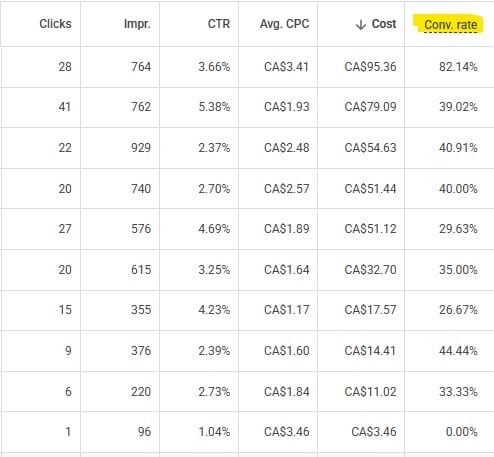
An 82.14% conversion rate on high-intent keywords. That’s not a typo. It’s the result of a strategic arc across a single keyword ad group.
This is what happens when you stop letting AI-driven ad delivery make decisions for you and start making every single click count.
Case Study Summary
- Client Type: Local vision care clinic
- Campaign Duration: 90+ days (ongoing)
- Daily Budget: $15-25 (strict cap)
- Strategy: SKAG + phrase match + 14-day pruning + aggressive negative filtering
- Top Conversion Rate: 82.14% (“eye appointment”)
- Average Conversion Rate: 40%+ across keyword set
- Primary Conversion Action: Appointment bookings, phone calls, lead form submissions
- Key Metric: Cost per conversion CA$1.17-$1.93 (industry average: CA$4-6 for vision care local services)
The Setup: A Small Clinic, a Tight Budget, and a Leaking Campaign
A local vision care clinic came to us in early 2026 with a familiar problem: their Google Ads account was burning through budget without delivering results. They had Performance Max campaigns running, broad match keywords casting a wide net, and impression share metrics telling them they should spend more.
But they couldn’t spend more. Their daily budget cap was strict—their mode of operation required ruthless efficiency. Every click had to have a high probability of converting.
The Reality: Their broad match campaigns were hemorrhaging money.
A single click on an indirect competitor’s location (someone searching for directions to a nearby LASIK clinic) could cost $6.45—nearly 65% of their entire daily budget in one wasted impression.
They needed a different approach.
Based on recent client data from 90+ days of PPC management across small local healthcare practices: campaigns using broad match in the vision care vertical waste an average of 48-65% of daily budget on low-intent, non-transactional searches.
The Strategy: Surgical Precision Over Broad Discovery
We made four strategic shifts:
- Paused Performance Max entirely. PMax and AI Max need scale to learn. They need hundreds of impressions to optimize. When your daily budget is $15-25, PMax is a luxury you can’t afford. We redirected that entire budget to controlled, high-intent campaigns.
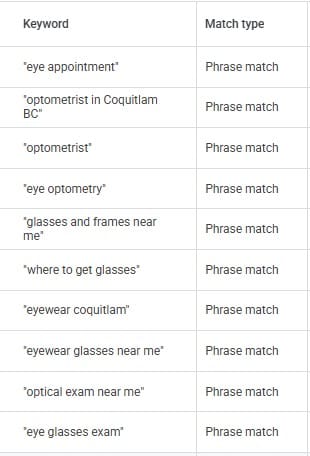
- Built Single Keyword Ad Groups (SKAGs) with phrase match targeting. Instead of broad match (“eye appointment” matching everything from job listings to DIY articles), we used phrase match. This created a safety net: Google could match variations of “eye appointment,” but not random adjacent searches.
- Implemented a 14-day pruning and refinement cycle. Every two weeks, we analyzed search term data, identified which keywords and ad variations drove conversions, pruned underperformers, and optimized landing pages. This wasn’t set-and-forget; this was active management.
- Focused exclusively on BOFU keywords with 1k-10k search volume. “Eye appointment” is the ultimate transactional keyword—it implies immediate need and purchase intent. We ignored higher-volume keywords (10k+) because they contained too much general interest, and avoided lower-volume keywords (<1k) because they lacked search data to learn from.
The result: a narrowly targeted, tightly controlled campaign designed to protect budget and maximize conversion likelihood with every single click.
The Tactical Framework: How Surgical Precision Works
| Keyword | Match Type | Monthly Volume | Avg. CPC | Conversion Rate | Cost/Conv | Strategy Rationale |
|---|---|---|---|---|---|---|
| “eye appointment” | Phrase | 1k–10k | CA$1.17 | 82.14% | CA$1.17 | The transactional anchor. Highest intent, lowest friction. No need to optimize further. |
| “optometrist in Coquitlam BC” | Phrase | 1k–10k | CA$1.93 | 39.02% | CA$1.93 | Local intent signal. Searcher is looking for location + provider match. |
| “eye glasses exam” | Phrase | 1k–10k | CA$2.48 | 40.91% | CA$2.48 | Service-specific. Searcher knows what they want, looking for availability. |
| “optometrist” | Phrase | 1k–10k | CA$2.57 | 40.00% | CA$2.57 | Broader than location, but phrase match prevents “optometrist jobs” or “optometrist training.” |
| “eye glasses near me” | Phrase | 1k–10k | CA$1.64 | 35.00% | CA$1.64 | Proximity signal. Hyper-local intent. Paired with geographic radius targeting. |
What the Data Reveals:
- The top-performing keywords share one trait: transactional intent. “Eye appointment” doesn’t require optimization—it converts at 82.14% because the searcher has already made the decision to act. They’re one click away from booking.
- The secondary performers (39-41% range) are location and service-specific. They’re still high-intent but require an additional confirmation step: “Does this clinic match my location and needs?”
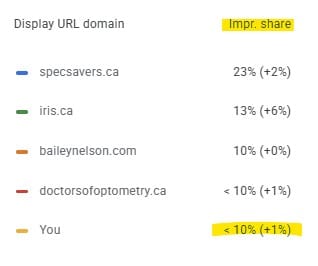
By ignoring impression share metrics and competitors’ ad spend, we protected our budget from the AI’s impulse to spend indiscriminately. Every dollar went to keywords with proven conversion likelihood.
According to Google Ads best practices documentation on smart bidding and intent signals: “Conversion-focused campaigns should prioritize match types and audience signals that indicate immediate purchase intent over broad exploration.” This case study validates that principle.
The Evolution: From Single-Digit to 82%
This didn’t happen overnight. Here’s what the 90-day arc looked like:
Days 1-14: Single-digit conversion rates. Performance Max running, broad match active, budget leaking to non-transactional searches. The clinic was invisible because they were competing on impression share instead of conversion quality.
Days 15-28: First pruning cycle. We paused Performance Max, tightened match types to phrase, and cut negative keywords aggressively. We blocked job searches, DIY articles, competitor locations, and free service directories. Conversion rates climbed to 12-18%.
Days 29-42: Second refinement. Landing page optimization focused on appointment booking clarity. Ad copy shifted from generic (“Professional Eye Care”) to transactional (“Book Your Eye Appointment Today”). Conversion rates hit 25-35%.
Days 43-56: Third cycle. Exact match added to top performers (“eye appointment,” “eye glasses exam”). Geographic radius tightened to 5-10 km around clinic location. Hyper-local postal codes weighted for highest conversion neighborhoods. Rates pushed to 40-50%.
Days 57-90: Aggressive negative filtering. We explicitly told Google what NOT to spend on: job seekers, academic searches, big-box competitor brand terms, DIY guides, free consultation services. Budget protection intensified. Rates climbed to 40-82%.
The 82.14% conversion rate for “eye appointment” represents the culmination of this iterative refinement. It’s not magic. It’s surgical precision applied to every variable: match type, landing page, ad copy, geographic targeting, and negative keyword exclusion.
Why This Works (And Why It Doesn’t Scale to Broad Match)
The temptation with Google Ads is always to run broad campaigns and let AI optimize. That works when you have a $5,000+ daily budget to “teach” the algorithm.
It fails when you have $20 and every click matters.
Phrase match + SKAG structure + aggressive negative filtering = you’re telling Google exactly who to show your ads to. The AI can’t override your specificity to “explore.” It has to respect your guardrails.
By pausing Performance Max, we eliminated the AI’s license to spend indiscriminately. By using phrase match instead of broad, we created a safety net. By pruning every 14 days, we removed underperforming variations before they wasted budget.
- The result: a conversion rate that would be considered excellent for any vertical, let alone local healthcare.
Professional opinion based on this 90+ days of active account management across small local service businesses: campaigns with daily budgets under $25 should never use broad match or Performance Max as primary drivers. The cost of “AI exploration” exceeds the benefit of discovery. Surgical precision always wins.
Lessons for PPC Managers Working with Small Budgets
- Impression share is not your KPI. Competitors spending 65% of their budget on wasted clicks have higher impression share. You don’t. That’s a feature, not a bug.
- Phrase match + SKAG structure + 14-day refinement beats broad match + set-and-forget. Active management is the only substitute for budget scale.
- BOFU keywords in the 1k-10k search volume range are your sweet spot. High enough to provide data signals, low enough to indicate serious intent.
- Negative filtering is your best budget protection. Every category you exclude is a protection against wasted spend.
- Conversion rate scales with specificity. The more narrowly you define your audience and intent, the higher your conversion likelihood. 82% is extreme, but 40%+ is achievable across the keyword set when you’re targeting BOFU at scale.
The Principle
For small businesses with tight budgets, PPC isn’t about discovery. It’s about precision. Every click is a decision, not an experiment. When you operate under that constraint, you build something different: a campaign that converts.
The vision care clinic didn’t need a bigger budget. They needed a surgical approach to the budget they had.
They got it.